Introduction: What Is the Neuroaffirming Philosophy?
For decades, the conversation around neurodivergence has focused on the perceived deficits of the individual, aiming to change neurodivergent people to fit a societal standard built by, and for, a neurotypical world. The focus has been on changing a person to make them seem “typical,” rather than accepting the whole person for who they are, and supporting their unique experience and support needs. By outgrowing the ‘fix-it’ approach, we can finally begin to validate the diverse wiring of the human brain as a natural part of human diversity.
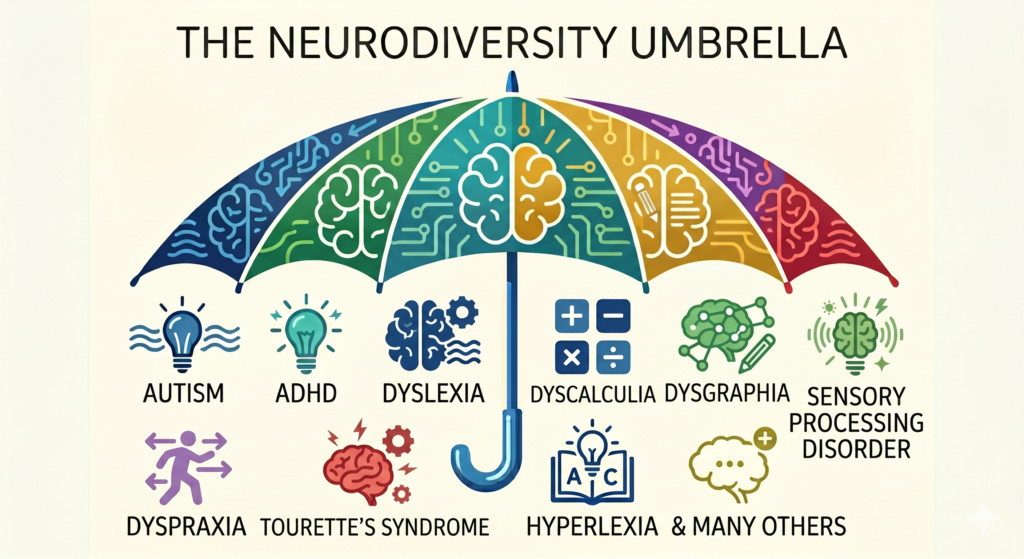
The neurodivergent umbrella is broad, and every part of it is valid. While many neurodivergent people experience disabilities that are not always immediately obvious, they are no less real than a physical disability. We would never expect a person who uses a wheelchair to simply “get up and walk” to prove their value, or to enter a building without a ramp; we recognize that the barrier is the stairs, not the person.
The same logic must apply to the brain. All disabilities are valid, and all neurotypes are valid.
The Neuroaffirming Philosophy is built on the intersection of modern neuroscience and the lived expertise of the neurodivergent community. This guide is for the caregivers ready to move from a “fix-it” mindset to a “support” mindset, as well as the advocates spreading the philosophy to their kids’ broader village.
At its core, being neuroaffirming means recognizing that neurological differences—like Autism, ADHD, Dyslexia, and many others—are natural variations of the human genome. They are differences to be supported, not deficits to be cured.
Main Idea: Neurodivergence is a difference—not a deficit
Understanding Neurodiversity
What Is “Neurotypical”?
To understand neurodivergence, we must first define neurotypical. This term describes individuals whose neurological development and functioning align with what society has historically defined as the “standard.”
A neurotypical brain processes sensory information, social cues, and executive tasks in a way that the world was specifically designed to accommodate. Being neurotypical is not a “correct” way of being; rather, it is a state of being “in sync” with societal expectations. Because our systems are built by and for neurotypical people, those with this neurotype often move through life without having to think about their neurological needs—this is often referred to as neurological privilege.
The Neurodivergent Umbrella
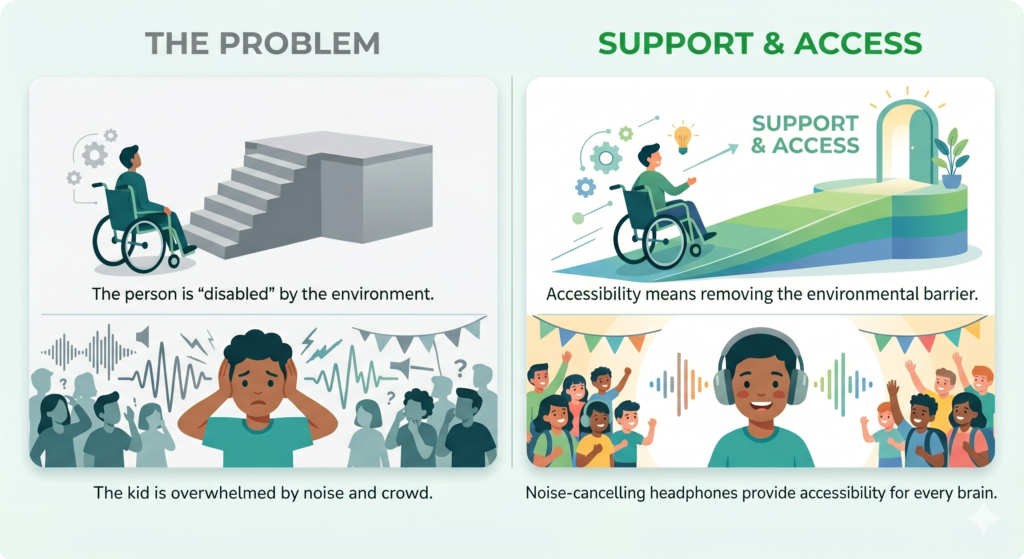
Neurodivergent is the umbrella term for those whose brains function outside of those societal standards. This includes, but is not limited to:
- Autism: Differences in social communication and sensory processing.
- ADHD: Variations in executive function and dopamine regulation.
- Learning Differences: Such as Dyslexia, Dysgraphia, and Dyscalculia.
- The Full Spectrum: This also encompasses Tourette’s Syndrome, Sensory Processing Disorder (SPD), Dyspraxia, and mental health profiles like OCD or CPTSD, and more.
Within this umbrella, some individuals hold formal medical diagnoses, while others self-identify as neurodivergent. Because traditional diagnostic barriers—such as cost, gender bias, and lack of access to specialists—can make a formal “paper” diagnosis difficult to obtain, self-identification is widely recognized and respected within the neurodivergent and neuroaffirming community. Whether a person’s journey started in a doctor’s office or through a profound realization of their own lived experience, their neurotype and their need for support are equally valid and respected in the neuroaffirming community.
The Evolution of Perspective: Medical vs. Social Models
The way we support neurodivergent individuals is deeply rooted in how we choose to view them. For a long time, society has relied on a specific framework to define “disability,” but as we learn more from the neurodivergent community itself, that framework is shifting. This shift in perspective is often described as the transition from the Medical Model to the Social Model. How we perceive neurodivergence—whether we see it as a problem to be solved or a fundamental way of being to be supported—directly shapes the way we interact with and care for neurodivergent individuals.
The Medical Model (The Pathology Paradigm):
Historically, the medical model views neurodivergence as a “disorder” or a “defect” to be cured. It focuses on suppressing natural traits and changing behavior to appear more “normal.” This approach often leads to “masking” and long-term psychological trauma. Masking occurs when a person who is neurodivergent suppresses their natural traits to appear neurotypical. While it can help a person navigate a world not built for them, it is a survival response that often leads to burnout, loss of identity, and anxiety.
The Social Model (The Inclusion Paradigm):
The social model suggests that while an individual may have specific support needs, it is the lack of societal accommodation that creates the true barrier to participation and engagement. Just as a person who uses a wheelchair is only “disabled” by a flight of stairs, a neurodivergent person is often “disabled” by an environment that lacks the necessary sensory or cognitive supports. In this view, neurodiversity is not a problem to be fixed; it is a natural variation of human existence. By providing the right “metaphorical ramp”—whether that is a quiet workspace, visual aids, sensory support or extra processing time—the focus shifts from changing the person to removing the obstacles in their path.
We embrace the Social Model because it protects a child’s mental health and sense of self. By shifting the ‘problem’ from the child to the environment, we stop the cycle of shame and start a cycle of empowerment.
When we stop asking ‘What is wrong with you?’ and start asking ‘What is getting in your way?’, we protect a child’s self-esteem. We teach them that they are not the problem—the barrier is—which allows them to feel valued and safe enough to truly engage with the world.
From Deficit-Based to Strength-Based Thinking
If the Social Model tells us why we need to change our perspective, a strength-based approach shows us how to do it.
Historically, support has been “deficit-based,” meaning it starts by looking for what a child lacks. A neuroaffirming approach is “strength-based,” meaning it starts by identifying a child’s unique interests, talents, and internal drive, using those as the foundation for their growth.
A Brief History of the Shift
This transition didn’t happen in a vacuum. It began with the Neurodiversity Movement in the 1990s, led by neurodivergent advocates who demanded to be seen as whole people rather than “cases” to be managed. Today, this movement is backed by Polyvagal Theory, which provides scientific evidence that the brain cannot learn or engage unless it feels a fundamental sense of safety.
Note: An Evolving Movement The neuroaffirming movement is not a static set of rules; it is a living philosophy. As our understanding of the brain deepens and more neurodivergent voices are elevated, our strategies will continue to shift. We are lifelong learners alongside the community.
The Traditional Compliance Model (The “Target” System)
For decades, the dominant approach to neurodivergence has focused on compliance—the act of following a command regardless of how one feels. This often involves a “target” system, where a child is required to perform specific behaviors (like forced eye contact or sitting perfectly still) to earn a reward.
When we prioritize compliance, we unintentionally teach children to ignore their own boundaries and bodily signals to please others. This “performance” is a primary cause of burnout and mental health struggles in neurodivergent people.
The Neuroaffirming Model (The Autonomy Paradigm)
In a neuroaffirming model, we replace compliance with Autonomy—the right to self-govern. This means respecting a child’s right to say “no,” to stim to regulate their nervous system, and to communicate in ways that feel authentic to them.
By focusing on autonomy, we aren’t just “getting through the day”; we are building essential self-advocacy skills. We are teaching the child that their voice matters and that they have the right to exist comfortably in their own skin.
Core Principles of the Neuroaffirming Approach
Embracing a neuroaffirming approach is about building a foundation of respect and understanding that honors how a person actually experiences the world.
These principles are not a list of rules to follow, but a framework for how we view and approach neurodiversity and neurodivergence. It is an ever-evolving philosophy that grows as we listen to and learn from neurodivergent voices.
When we embrace these principles, we aren’t just following a guide; we are prioritizing the lived experience of each neurodivergent person and respecting their right to exist as their authentic selves.
- Presume Competence: Never assume a child doesn’t understand.
- Behavior Is Communication: Every “meltdown” or “challenging moment” is a message about an unmet need.
- Autonomy and Consent: Respect and empower a child’s boundaries and their right to self-govern.
- Sensory Needs Are Real Needs: Sensory regulation is a biological requirement, not a preference.
- Strengths-Based Support: Lead with a child’s natural interests and internal drive rather than focusing on “deficits.”
- Regulation Before Expectation: Emotional and physical safety must be established before learning or engagement can happen.
The Power of a Neuroaffirming Village
These principles have the greatest impact when they are prominent in every part of a child’s life, and neuroaffirming care is most powerful when a child is surrounded by a village that shares this consistent approach—from immediate family and caregivers to the extended family, friends, and educators who make up their inner circle.
By listening to and learning from neurodivergent voices, we ensure that our collective understanding continues to grow, and our neuroaffirming village continues to grow along with it. When the adults in a child’s life are aligned in this way, the child receives an important and consistent message:
“You are safe, you are understood, and you belong exactly as you are.”
Practical Neuroaffirming Strategies
What makes a strategy “Neuroaffirming”?
A strategy is neuroaffirming when its primary goal is to support a child’s nervous system rather than to modify their behavior. Unlike traditional methods that ask a child to suppress their natural traits to fit a standard, these strategies adjust the environment and our expectations to meet the child where they are. We use them because when a child’s sensory, emotional, and communication needs are met, their capacity to engage and learn naturally increases.
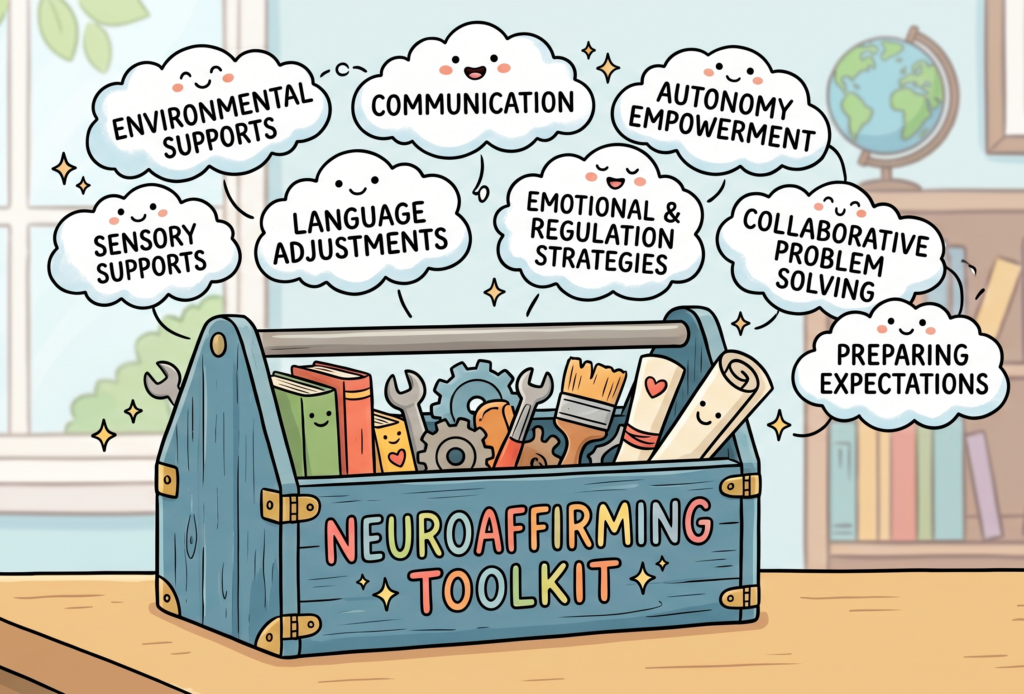
Environmental Supports: Setting the Stage for Success
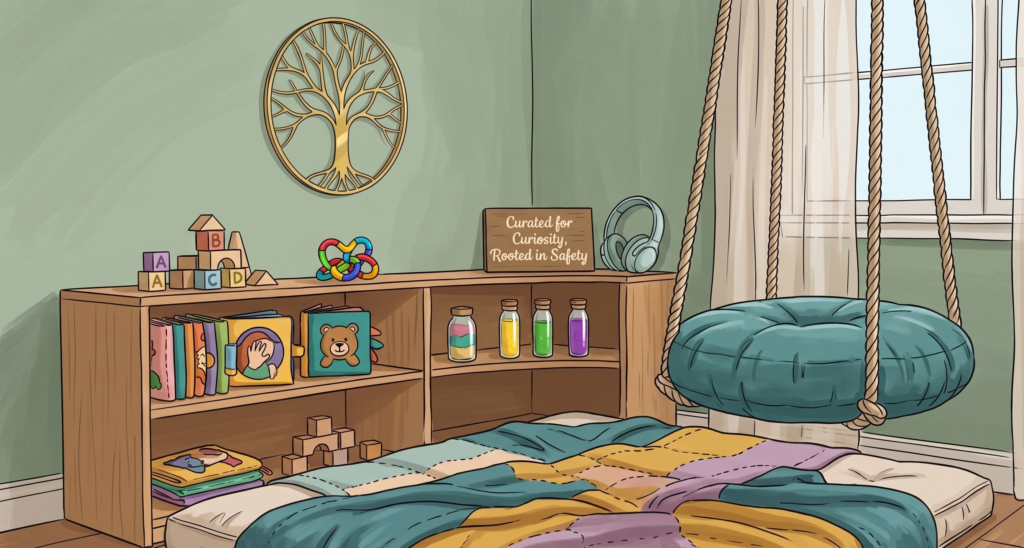
Environmental supports recognize that the physical space around a child can either be a barrier or a bridge to participation.
- Sensory “Yes” Spaces: Curating areas specifically designed for high-energy input—such as crash pads, swings, or swivel chairs—where a child never has to be told “no” for seeking the movement their body requires.
Sensory Supports: Protecting the Nervous System
These strategies involve actively managing the sensory input a child receives to prevent “sensory overwhelm.”
- Controlling Sensory Load: Making intentional adjustments like dimming fluorescent lights, using noise-canceling headphones, or providing “sensory breaks” in a quiet area before a child reaches a state of burnout.
- Movement Integration: Active seating or “heavy work” opportunities that allow a child to move while they work, recognizing that for many, movement is a prerequisite for focus.
Communication: Valuing Every Voice
Neuroaffirming communication assumes that all forms of communication are equally valid, whether they are spoken or not.
- Respecting Multi-Modal Communication: Valuing and encouraging the use of AAC (Augmentative and Alternative Communication), gestures, lead-taking, and “scripting” (Echolalia). We listen to the intent of the message, not just the delivery.
Language Adjustments: Invitations vs. Demands
The way we speak can either trigger a “fight or flight” response or invite collaboration.
- Positive Reframing: Transitioning from restrictive “No/Stop” commands to supportive, action-oriented invitations. By framing our words around what is available—such as saying, “Let’s use walking feet to stay safe” instead of “Stop running”—we provide the brain with a clear path forward and invite the child into a partnership rather than a power struggle.
- Clarity & literal language: Many neurodivergent individuals tend to process language literally and concretely. Clear, direct communication removes the need to decode subtext, implied meaning, or social nuance, which can be exhausting and lead to misunderstandings.
- Declarative Language (particularly supportive for PDA profiles): It is also important to acknowledge that demands can be triggering for some neurodivergent kids. When communicating with a kid with a demand avoidance profile, shifting from imperative commands (direct orders like “Put your shoes on”) to observational statements (“I notice the sun is out and we’ll need shoes for the park”) can be a game changer. This shares information without the pressure of a direct demand.
- Low-Demand Phrasing: Consciously reducing the “weight” of requests during high-stress times to help a child maintain regulation.
Autonomy Empowerment: Honoring Agency
These strategies prioritize the child’s right to exist as an independent person with their own boundaries.
- Body Autonomy: Respecting side-by-side interaction and “bottom-up” listening rather than forcing eye contact or specific “whole body listening” postures.
- The “10-Second Rule”: Giving the brain ample time to process verbal input before repeating a request. For many neurodivergent brains, a “slow” response is simply a “processing” response.
Emotional & Regulation Strategies: Connection Over Control
These are the tools we use to maintain safety and connection during difficult moments. Regulation before expectation.
- Co-Regulation Over “Time-Outs”: Moving away from isolation and instead staying with a child during distress to offer the calming presence of our own regulated nervous system.
- Identifying “Glimmers”: Actively seeking out the child’s strengths and deep interests and using them as a “bridge” for connection and joy.
- The Safety Check: A constant internal audit for the caregiver: “Does this child feel safe right now?”
Collaborative Problem Solving: Partnering with the Child
This approach shifts the focus from managing behavior to solving the “why” behind a struggle through partnership.
- Solving the Struggle: Instead of imposing a solution, we sit with the child to identify the lagging skill or unmet need. Together, we brainstorm a resolution that respects both the child’s needs and the caregiver’s concerns.
Preparing Expectations: Providing Predictability
- Visual Schedules: Providing visual schedules, “now/next” boards, or timers to set clear expectations. This reduces the “cognitive load” required to guess what comes next, lowering anxiety.
- Custom Social Narratives: Rather than telling a child how to behave, individualized social narratives provide the “insider information” needed for the child to feel safe in new, unfamiliar, and challenging situations. These are stories specifically scripted and tailored to the individual child. By describing what to expect—the sequence of events, who will be there, and what the sensory environment will feel like—we remove the “unknowns” that often trigger anxiety. This supportive tool empowers the child to navigate their world with confidence, knowing they have a predictable map for the journey ahead.
Your Growing Toolkit
While these neuroaffirming strategies offer a strong starting point for any village, it is by no means exhaustive. Because neurodivergence is as unique as a fingerprint, your neuroaffirming toolkit will naturally grow and shift as you learn the specific rhythms and unique needs of each child in your life.
What Neuroaffirming Is NOT
It is a common misconception that neuroaffirming care means a lack of boundaries or “permissive” parenting. In reality, it is a deeply structured approach that maintains safety through empathy rather than shame.
Neuroaffirming care is not about removing expectations; it is about ensuring those expectations are fair, accessible, and biologically respectful. It is not about “giving in”—it is about choosing supports that prioritize a child’s sensory comfort and authentic identity over the societal pressure to “seem typical.”
Real-Life Examples & Using Neuroaffirming Care
This is where we reframe common misunderstandings into neuroaffirming actions:
The “Defiance” Scenario
When a child refuses a task, we pivot from seeing “defiance” to seeing “overwhelm.”
Neuroaffirming Pivot
“I see this is hard. Let’s do the first one together.”
The “Public Meltdown” Scenario
When a child meltdowns in public, we pivot from “needing discipline” to “needing regulation.”
Neuroaffirming Pivot
Moving to a quiet space to provide sensory safety and coregulation.
The “After-School” Scenario
When a child appears fully regulated in the classroom but “melts down” at home, they are likely experiencing after-school restraint collapse.
Neuroaffirming Pivot
Providing a low-demand, high-sensory-support and co-regulation environment immediately after school to allow the Mask to safely drop.
While these pivots help in the moment, integrating this philosophy into your daily life is a gradual process.
How to Advocate this to the Village:
“I know you care. We are focusing on regulation before expectation. They are in ‘fight or flight’ right now; a punishment will only increase distress. The best way to help is to stay calm with me.”
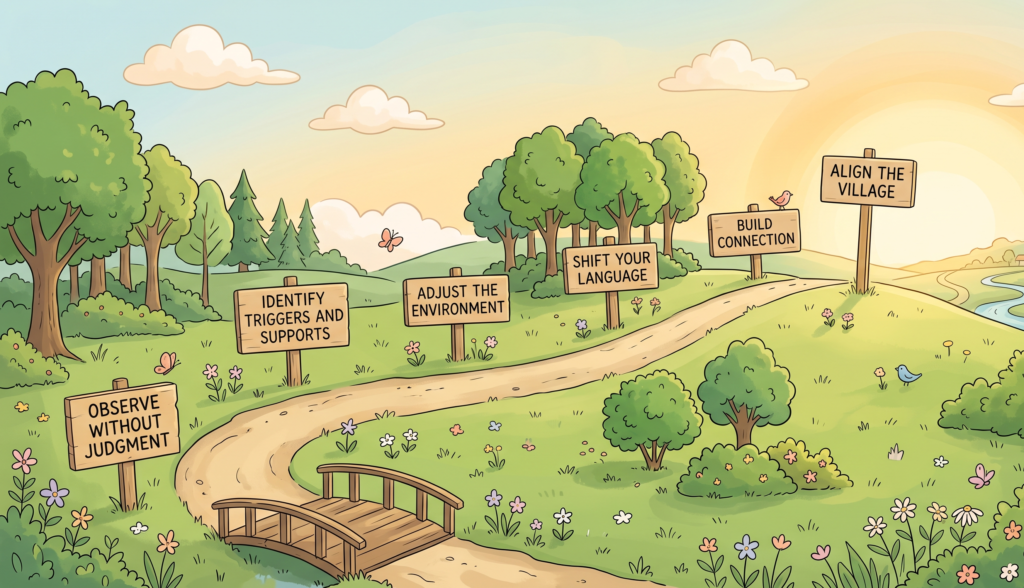
Getting Started: The Simple Action Plan on Integrating the Philosophy
Whether you are new to embracing the neuroaffirming approach yourself, or are here to advocate for your child within their village, transitioning to this philosophy is more than a set of steps to complete—it is an ongoing shift in perspective. It is the daily practice of unlearning old habits to make room for new, supportive rhythms. By starting here, you are stepping into the vital role of a safe space curator.
- Observe without judgment.
- Identify triggers and supports.
- Adjust the environment.
- Shift your language.
- Build connection.
- Align the Village.
Deep Dives: The Science & Voices Behind the Philosophy
If you find yourself wanting to dive deeper into the research and lived experiences that inform this framework, these resources are the best place to start. While new research is constantly emerging, these foundational works remain essential for understanding the neuroaffirming movement.
- Polyvagal Theory (Dr. Stephen Porges) – Understanding the biological “safety” switch.
- The Double Empathy Problem (Dr. Damian Milton) – A landmark concept on neurodivergent social communication.
- Collaborative & Proactive Solutions (Dr. Ross Greene) – The framework for solving problems without power struggles.
- Beyond Behaviors (Dr. Mona Delahooke) – Shifting from behavior management to brain-based support.
- The Neurodiversity Paradigm (Dr. Nick Walker) – Foundational reading on the shift in human consciousness regarding neurotype.
Final Thoughts: You are a Safe Space Curator
If you’ve made it this far, you are doing more than just reading—you are investing in a future where neurodivergence is celebrated, not just “managed.” By trading the pressure of milestone charts for the power of felt safety, you are officially acting as a safe space curator.
This journey is about progress, not perfection. By choosing to be a safe space curator and prioritizing regulation before expectation, you are ensuring your child knows they are worthy of belonging exactly as they are. You are their guide, their advocate, and their greatest support.
Grow Your Kid’s Village
Neuroaffirming care flourishes when the entire community is in sync. Think about the people who make up your child’s village—is there a special someone who would love to learn more about this approach?
Sharing this philosophy is the fastest way to build the supportive environment your child deserves. By passing this guide along, you are helping your village grow into a kinder, more inclusive space where your child can truly feel like they belong.
We Invite You to Stay Connected
- Join Our Newsletter
- Read Our Blog at the Kind Caregivers Club
- Create in the NeuroKind Studio
- Find Us On Social